Monday, February 24, 2020

Fishing Line Entangled Turtle

2/23/2020
Sunday

Below is the information about a turtle that Ms Jim and I worked on Sunday afternoon.  It was entangled in fishing line and we were able to remove the line and set it free.


Location:  Hilton Waikoloa, Waikoloa, Hawaii Island, Hawaii
Responders: Marc Rice and Laura Jim
Date:  2/23/2020
Time:  1230 h
Grace from the Hilton Lagoon area called to say that they had a turtle entangled with fishing line.  They had captured the turtle and put it into a secure area in the shade.  We made our way down to the Hilton, arriving at 1350 hours.  Security escorted us to the lagoon where we found the turtle in good condition.  
We proceeded to remove what was left of the fishing line (they had removed most of it already). Because the left front flipper was seriously cut into and swolled, we looked carefully and deeply into the wound to make sure that there was no line left.. we removed a few lengths of line but there appeared to be no more line encircling the flipper.  While it was swollen, it appeared that the turtle still had use of the flipper and there was no necrosis evident.  Consequently, we decided that it was ok to release the turtle in the hope that with the restriction removed, the fin could heal.
In addition to the flipper entanglement, there was one strand of line going down the throat.  Hook was not visible so the line was snipped off as short as possible deep in the throat regions.

The turtles was previously tagged so we measured it and put moto tool number HA101 on the 3rd left lateral scute.
Date:  2/23/20
Time of release back to water:  1430
Location:  19.925030 N  155.888020 W
Species:  Cm
Tags:  LH 4C3B400A3E
           RH 4C3B601863
   MT: HA101
CCL = 57.0
CCW = 49.5
Body Condition:  Very Robust

Turtle was safely released at 1430 h and swam away vigorously.

Ms Jim transfers the hone to a carrier so that we can work at removing the fishing line.  Note that the honu is very "plump". 
The Fishing line had cut into the left front flipper about 1/4" to 3/8" but the honu still had use of the flipper.  We were able to remove the line from the flipper but one strand was going into the mouth and we were unable to  remove all of it.  Hopefully, the turtle will be able to pass the line that was swallowed.


We added a moto tool number so that snorkelers could report when they see the honu.


An appreciative group of tourists watched as we tended to the honu.  The honu was observed and captured by some guests at the hotel... we are very appreciative of their efforts and the wonderful cooperation and help we got from the hotel staff.

Time to release our honu.


Being release.


High five after the turtle swam vigorously off.


This is the type of line that was entangling the honu- very dangerous stuff for a honu.


Saturday, February 8, 2020

Line Entangled Sea Turtle

Sunday, 2/2/2020

RESCUE OF ENTANGLED TURTLE AT HILTON WAIKOLOA

A text from Dolphin Quest (DQ) (1421 h) said  that a tourist reported a basking turtle with fishing line around its flippers.  The personnel at DQ agreed to go and keep an eye on the turtle while I drove down. I got there at 1455 h and walked out to the area where they were observing the turtle.  We restrained the turtle and removed the fishing line from around the left and right front flippers.  There were no injuries from the entanglement.  On viewing the ventral side I noted that the plastron was sunken.. Emaciation code 1.
The DQ team kept an eye on the entangled turtle in case it decided to go back in the water.  

This 60 cm turtle (CCL) had fishing line around its two front flippers and its neck.  We were able to remove the line without problem.

Here is the line and golf ball "sinker" that was around the flippers and neck of the Honu. 


Here I apply a PIT tag to the left hind flipper of the honu.

With all the line removed, the honu looks healthy and ready for release.

The team DQ and I lift the turtle up and transport it back to the water for release.

Two PIT tags were applied (LH and RH)-see below
Turtle was released at 1540 and swam away vigorously.

Location: 
19.926932°N
155.886793°W
Species:  Cm
CCL = 63 CM
Time of Capture:  1515 h
Time of Release:  1540 h
New Tags:  LH = 4C3D133F2F
                   RH =4853370C0E 
E CODE= 1

Total time for incident:  100 minutes.  Distance = 32 miles

Monday, February 3, 2020

Vanuatu Satellite Tagging Project- 2020

2/3/2020
From: Laura Jim, Associate Director, STRP

I wanted to take a moment and share a little info on HPA’s Sea Turtle Research Program’s work on conservation of sea turtles in the South Pacific earlier this month and the travels of our students!

On January 4th, 2020 3 students, Ali Wawner, Bayla Jefferson, and Ami Ibaramoto joined Marc Rice and I for our third research expedition to the Republic of Vanuatu.  As part of a three year we, working alongside Francis Hickey, Coordinator, Traditional Resource Management Program at Vanuatu Cultural Centre and Tassiriki villagers, placed satellite tags on three post-nesting hawksbill turtle on Moso Island in order to foster a better understanding of the location of their forage grounds and regional connectivity.  Our last four tagged turtles went to both New Caledonia and Australia. Where will these three go? If interested, you can follow their travels in the following blog.

In addition to deploying the satellite tags, we volunteered at the turtle hatchery at Moso Island’s Tranquility Resort tagging and collecting tissue samples for genetic analysis. Of course, there was some down time where we were able to explore the reefs of Moso and Lelepa Islands! 

Our students represented HPA and their families so well and I am so proud to say that all three of these students are products of our Village!. The three were extremely hard working, even in challenging conditions, were very respectful of all those we worked and interacted with, and were true scientists and marine biologists exploring the natural realm. They really seemed to appreciated their time with our village hosts. "I believe that meeting/spending time with local people from the island made the experience extra special. Because we were able to do so, we were able to better connect with their culture and learn.” reflected one student. In addition, all of the students really enjoyed exploring the reef system of Moso Island. "My greatest learning experience was learning about all of the different types of corals and different sea creatures that we don't see in Hawaii.” 

With great appreciation for our amazing students and our great school!  Laura

The HPA/NOAA/VANUATU team at the time of departure from Tranquility Resort, Moso Island.
Ali, Bayla and Ami (Marama in the background) at one of the tanks with baby hatchling Hawksbills.
The team with our large female hawksbill turtle with the satellite tag attached... we were waiting for the fiberglass and resin to harden sufficiently so we could release her.


Snorkeling on the beautiful coral reef of Moso Island.

Hiking across Moso Island to visit "Freds" beach.

One of two scuba dives we made.
Louis (caretaker of turtles) holds a juvenile hawksbill turtle while Ali prepares a flipper for a tissue sample for DNA analysis.


In the midst of tagging our first turtle.  The purple light is UV that helps to harden the polyester resin holding the tag in place.
The team off shore from Tassiriki Village after we visited to share the results of our work.

Friday, November 22, 2019

Kiholo and Puako Field Work

November 19 and 20

Three members of the NOAA Marine Turtle Biology and Assessment team came over to join our HPA team for two days of field work to capture and tag honu at Kiholo Bay and 22 Puako Beach Road, Puako, Hawaii.

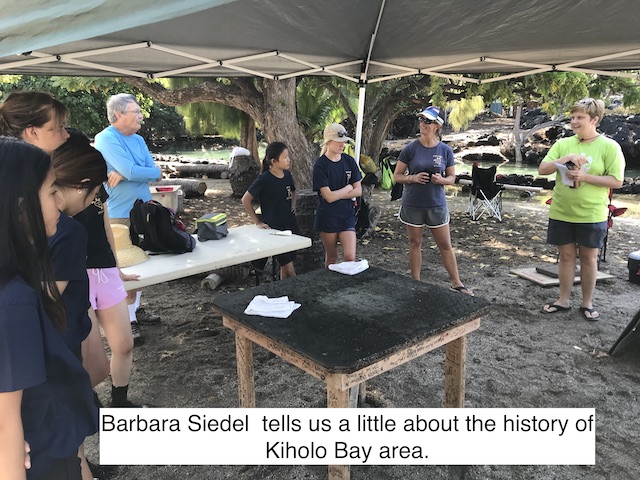
On Tuesday (11/10/19) We went to Kiholo bay hosted by TNC's Biologist, Barbara Siedel.  We arrived around 0900 hours, set up our work area and began capture and sampling work around 0930 h.
During the time from 0930 to around 1400 hours, we were able to capture and sample 10 honu.  The honu ranged in size from 5.4 kg to 40.8 kg and, of the 10 honu captured 5 were recaptures and 5 were new captures.  We were able to obtain blood and tissue samples from all 10 animals and all of them were tagged with oxytetracycline (a bone growth marker).  All animals were safely and harmlessly released with appropriate mototool numbers 82 to 89.
During the late morning and early afternoon, the weather turned a little sour and there was significant thunder and lightening which caused us to reduce and finally cancel our efforts at capturing and working up honu. 


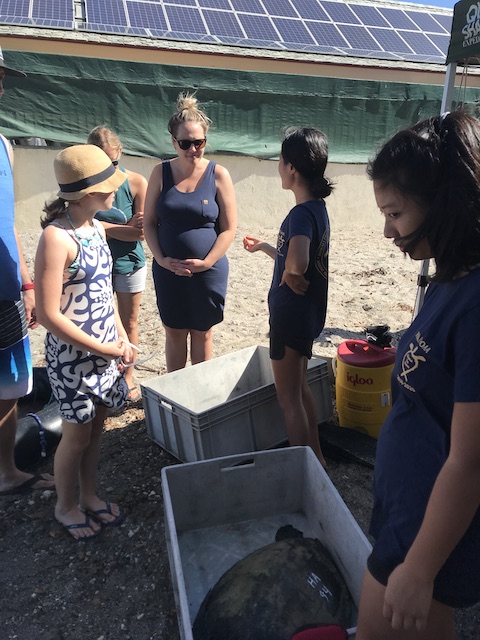
On Wednesday, 11/20/19, we picked up a second team of HPA students from the upper and middle schools and joined the MTBAP personnel once again.  This time we traveled to 22 Puako Beach Road and set up a working area at the public access area.  The weather was clear and there was a strong onshore wind with moderate swells from the west.  The tide was quite high which we thought might be a problem but we now think it was a blessing because the honu were in the area feeding in the morning.
The total for the two days was 21 honu captured, sampled and harmlessly released.    

We started capture work around 0930 h and were lucky to get animals on a pretty regular basis right up to 1200 h when we decided to break for lunch.  
At the end of the day, we had been able to capture and sample 11 honu.  10 of the 11 were new with only 1 recapture.  The size range was narrower that Tuesdays sample at Kiholo with a size range of 9.6 to 34.2 kg.  The size of the animals was more towards the large juvenile range with only one really small critter capture.
We were able to obtain samples from all of the animals and the mototools were applied (89 to 100!!!!)


Images from the two days.


The video above is a short sequence showing Ms. Jim, students and a NOAA scientist snorkel capturing a juvenile honu for weighing, measuring and tagging.  


Ms Jim loads an external tag applicator prior to applying a metal tag to the left hind flipper.


Ivanni explains what we are doing to some visitors.


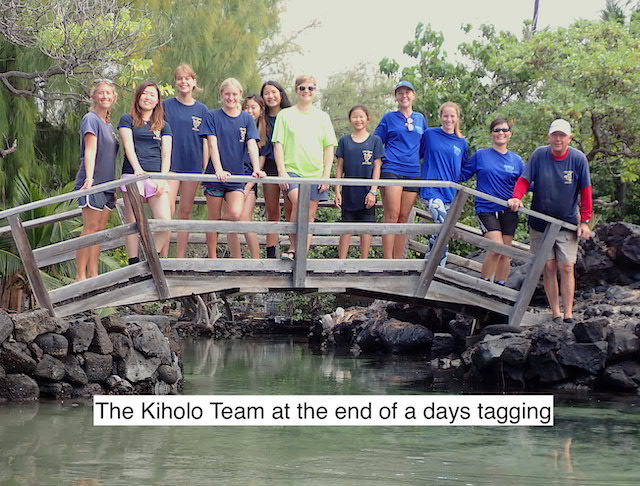
The Tagging Team at Puako.


Monday, November 4, 2019

Recent Tagging Trips-

During the week of October 22 to 24, HPA's STRP program joined the NOAA Marine Turtle Biology and Assessment Program to conduct three days of capture and sampling at Hualalai, Waikoloa and Mauna Lani.
The primary purpose of the field work was to collect blood samples to continue the sex ration study started back in April.  During the trips, HPA students assisted Laura Jim, Marc Rice (HPA) and Shawn Murakawa, Ali Balis and Camryn Allen (NOAA) to capture, tag, measure and draw blood samples from green turtles.
On Tuesday we went to Hualalai where we were hosted by the wonderful Four Seasons Resort team headed by David Chai.  During the day we were able to capture 7 honu.  All turtles were worked up (measured, weighed and blood drawn) and the HPA students Hikari Shaver, Ivanni Jamin and Jimmy Liu did the lab work that afternoon and froze the plasma collected.
On Wednesday we went to the Waikoloa Hilton where we were hosted by Tessa Cazimero (Hilton Biologist).  We were able to capture and work up 12 honu noting that they were well feed and quite plump!  The blood samples were worked up that afternoon by the same exemplary HPA team.
On Thursday, our last day of field work, we went to Mauna Lani Bay and were able to capture 8 honu.  After completing all of the field measurements and drawing blood, we returned to the lab and worked up the blood samples.
In all, we were able to collect 27 samples and worked up that number of turtles.
The team effort (HPA and NOAA) worked very well and everyone learned a lot from our visiting NOAA scientist.

Below are a few pictures from the three days of field work.

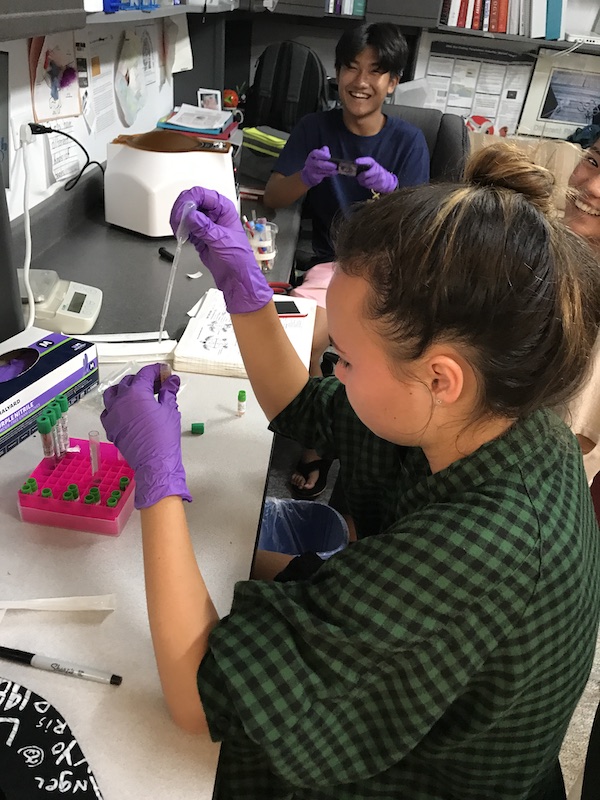
Hikari pipettes blood serum after centrifuging.  The serum is
put into cryovials and frozen in liquid nitrogen.
Charlotte returns a honu to the ocean after it was weighed and measured and a blood sample was taken.


The team of HPA students controls a small turtle on the work-up table.


Our worksite at Hualalai.

Our data taker!

Students control a honu while a harmless identifying number is etched into its shell.

The team releases a honu.

Ms Jim etches a number into the carapace.

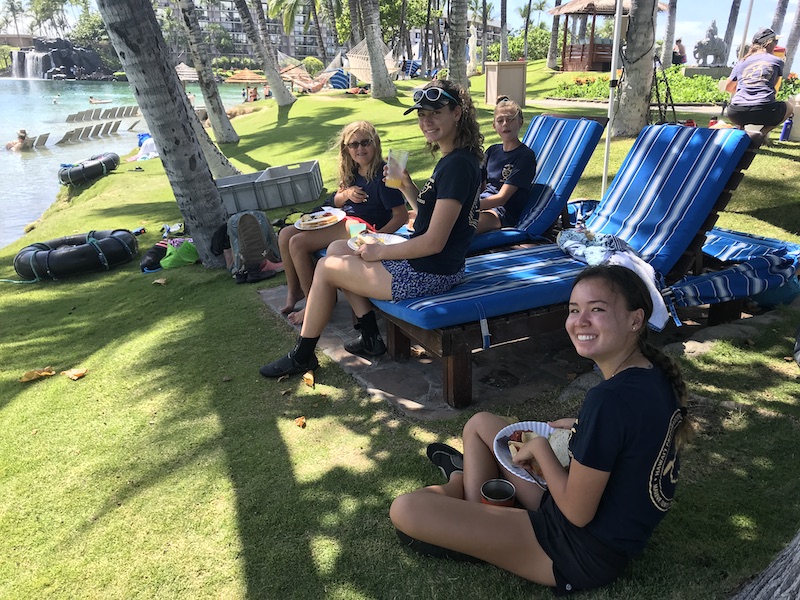
Lunch time at the Waikoloa Hilton Hotel.  We all enjoyed Laura's fresh squeezed juice!!!


Roughing it during lunch at the Waikoloa Hilton.
Our work area at the Waikoloa Hilton during High tide.


A student working on a honu at the Mauna Lani Bay site.

River takes a small tissue sample from the shoulder of a honu.

Ivanni accurately taking down data.


Mariko assists Ms Jim in taking data.

Jimmy does an oral exam.

Mr. Balazs took these pictures of the turtles feeding on algae at 0730 in the morning at the Waikoloa Hilton Water Fall.


Honu Health Assessment- 22 PBR

  November 5, 2024 Ava Williams ('87) was kind enough to once again grant us access through her property at Puako to conduct our yearly ...